Are the power dynamics of the past fit to empower the future?
By Liam King and Dale Bracegirdle, Future Leadership
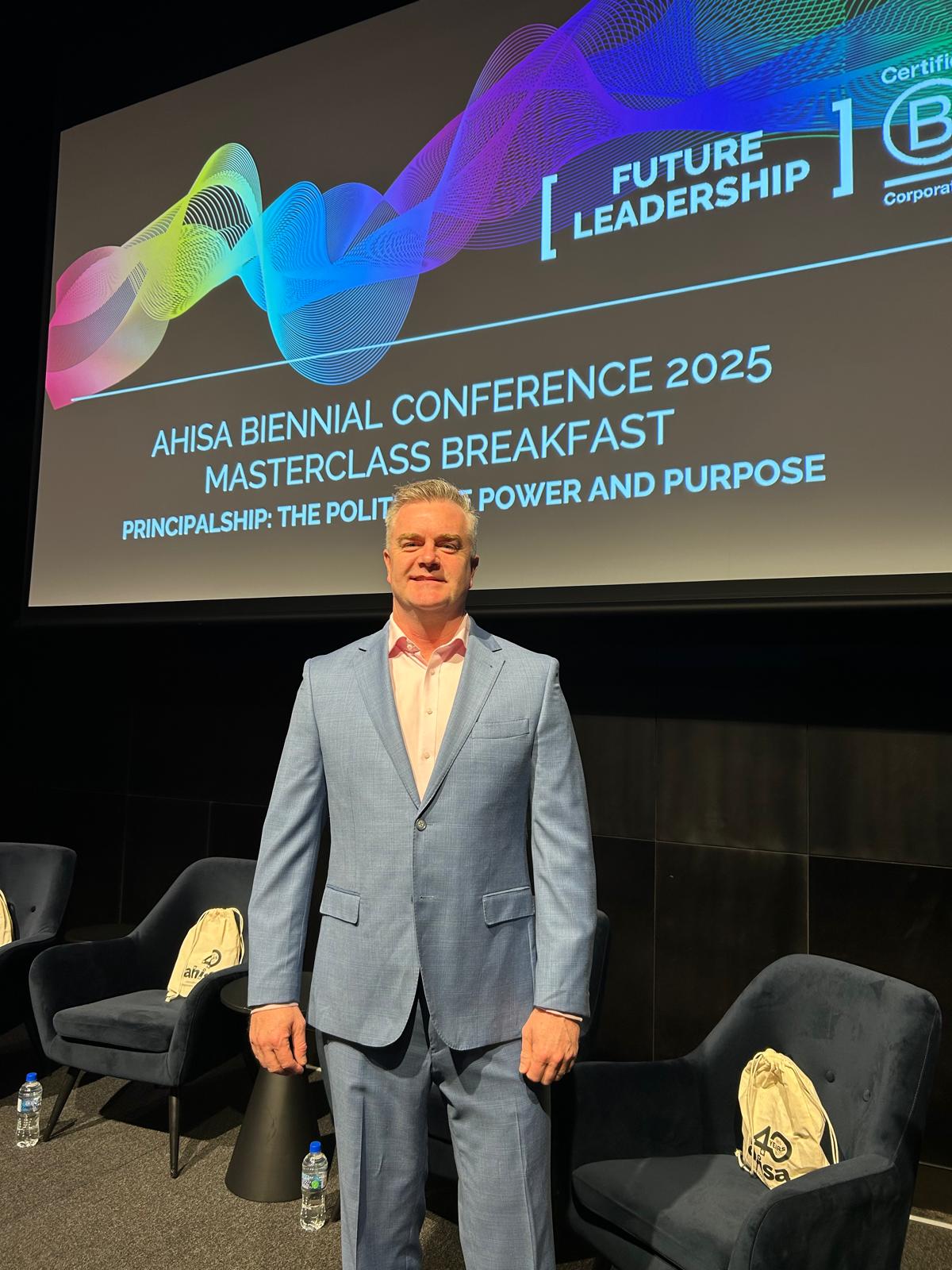
At the recent AHISA Biennial Conference in Wellington, we had the privilege of facilitating a leadership development masterclass on “Principalship: The Politics of Power and Purpose”. The learning forum culminated in a panel discussion alongside Michelle Carroll, Principal of Matthew Flinders Anglican College, and moderated by Judith Tudball, Principal of St Mary’s Anglican Girls’ School. The conversation that unfolded revealed something we’ve been observing across the independent schools’ sector for some time: the old models of leadership power are breaking down, and many senior leaders find themselves equipped with yesterday’s tools to solve tomorrow’s challenges.
The Māori proverb “Ka Mua Ka Muri”—walking backwards into the future—framed our exploration. It asks a provocative question: Are the power dynamics of the past fit to empower the future?
The Modern-day Struggle of Positional Power
During the panel discussion, a recurring theme emerged from the assembled principals and senior leaders: the traditional levers of authority simply don’t work the way they once did. One participant described the experience as “trying to drive an electric car using a manual written for a 1950s Holden.”
This resonates deeply with our work in leadership development. We’re watching capable, well-intentioned school leaders struggle, not because they lack capability or capacity, but because they’re operating from an outdated paradigm of power, one rooted in position rather than purpose.
Consider what we refer to as “positional power” in the independent schools context. It manifests as the leader who believes, “To maintain my influence, I must be seen to have the answers.” It drives short-term compliance through authority rather than building long-term commitment through alignment. Most critically, it collapses when you’re not present, and in today’s hybrid, distributed, and complex school environments, we can’t do it all, and we can’t do it alone.
The consequences are profound. Positional power breeds resistance and resentment among today’s teams. It creates dependency rather than developing leadership capability in others. It struggles to maintain connection in the very settings where modern education increasingly happens, the informal, the digital, the collaborative spaces where formal authority carries less weight.
The Shift to Purposeful Power
Real power in schools today is the trust your community chooses to give. This isn’t a platitude; it’s a fundamental reimagining of how influence works in educational leadership.
Personal power, or what we might call “purposeful power,” operates on entirely different principles. It’s earned by aligning hearts and minds around a shared purpose. It grows when we speak plainly and act with uncompromising ethics. It influences through human stories that invite commitment, not compliance. Most importantly, it strengthens in your absence because it’s embedded in culture and purpose, not dependent on your presence in the room.
Michelle Carroll’s words resonated during our panel, depicting this shift in her own leadership journey. The transition from needing to have all the answers to asking better questions (of herself and her team) fundamentally transformed how her leadership landed with her colleagues, students, and families. This isn’t about being less decisive; it’s to do with being more intentional about where your power actually comes from.
The Leadership Shadow Framework: A Diagnostic Tool
One of the most practical frameworks we shared during the masterclass was the Leadership Shadow concept, shared by our Advisor, Dr Amanda Bell, using concepts adapted from Larry Senn’s work. In essence, your leadership shadow is the sum of what you say, do, recognise, and prioritise. Each element casts its own influence:
What you say: To what extent do you openly talk about the importance of living your school’s purpose? Not just in formal addresses, but in daily interactions, crisis moments, and casual conversations?
What you do: What are you doing every day that makes your shared purpose compelling, even when you’re not in the room? Your actions send signals far more powerful than your words.
What you recognise: What are you consistently recognising and celebrating that advances your shared purpose and builds alignment? The behaviours you acknowledge become the behaviours you multiply.
What you prioritise: How are you prioritising your time, so your shared purpose is visible, and brings colleagues, students, families, and your community into genuine alignment?
The uncomfortable truth is that most school leaders discover significant gaps when they honestly assess their shadow. We speak eloquently about innovation but recognise traditional markers of success. We espouse collaboration but incentivise individual achievement. We declare student wellbeing paramount, but allocate time primarily to academic outcomes and operational issues.
Purpose-Power Integration: The Strategic Imperative
This is where capability building becomes critical. Understanding the theory of purposeful power is one thing; systematically integrating it into how your leadership team operates is entirely another.
We introduced a three-stage framework during the masterclass that we use extensively in our leadership development work:
Purpose Clarity: Can a ten-year-old in your school explain why your school exists at a deeper level? If your leadership team can’t articulate this with crystalline clarity, you cannot possibly align your community around it.
Power Assessment: Who holds formal authority over key decisions? Who holds informal influence over their success? Where does your leadership team have credibility, and where do you need to build it? Most leadership teams have never mapped this explicitly.
Strategic Alignment: How do you frame decisions to align with each stakeholder’s values? What resistance can you anticipate, and how do you address it pre-emptively? How do you make decisions feel collaborative while maintaining clear direction?
This integration isn’t intuitive. It’s a learnable skill set that requires deliberate practice and often an external perspective to master.
Navigating Stakeholder Power Dynamics
One of the most valuable discussions during our panel centred on the different political landscapes school leaders must navigate simultaneously. Internal politics (your team) require professional respect and relationship trust. External politics (parent community) demand results, clear communication, and accessibility. Governance politics need strategic thinking, fiscal responsibility, and compliance.
Each domain has its own power sources, purpose alignment requirements, and common traps. The internal trap is assuming your vision is automatically shared. The external trap is over-explaining the process while under-communicating the purpose. The governance trap is leading with compliance instead of vision.
Effective school leaders must fluently code-switch between these domains, not through manipulation, but through genuine understanding of what drives trust and alignment in each context. This is a sophisticated leadership capability that most people don’t naturally possess but can surely develop.
Why This Matters Now
The independent schools sector faces unprecedented complexity. Enrolment pressures, staff retention challenges, evolving pedagogical expectations, safeguarding imperatives, digital transformation, and community expectations that seem to expand daily. All of this requires leadership teams that can navigate politics with authenticity while staying anchored to purpose.
The schools that will thrive aren’t necessarily those with the most resources or the longest traditions. They’re the ones building leadership capability systematically throughout their senior teams.
Here’s what we consistently observe: most school leadership teams have never been explicitly taught these capabilities. They’ve inherited models of power from their own principals and cobbled together approaches through trial and error. Some have a natural aptitude for purposeful leadership. Most are doing their best with frameworks that increasingly don’t fit the environment they’re leading in.
This is precisely where strategic leadership development makes the difference. Not generic leadership training, but deep capability building specifically designed for the unique power dynamics and political complexities of independent school leadership.
At Future Leadership, our work with schools focuses on making these concepts actionable, not just intellectually understood but embedded in how leadership teams operate daily. We work with senior leaders to map their leadership shadows, identify gaps between intention and impact, and build practical capabilities for navigating stakeholder dynamics with both political acumen and authentic purpose.
The question: “Is the shadow you cast one of political authenticity and purpose?” is relevant to every school leader. Because your shadow is always there, whether you’re conscious of it or not, whether it’s serving your purpose or undermining it.
The power dynamics of the past won’t empower the future. But purposeful leadership, deliberately developed, assuredly will.
Ready to build purposeful leadership capability in your senior team?
Future Leadership partners with independent schools to develop leadership capabilities that align power with purpose. Led by Liam King (Education Practice) and Dale Bracegirdle (Learning & Development Practice), we bring deep expertise in both educational leadership and systematic capability building.