
Leadership in the Public Sector is rising to meet the many challenges of the day. Public servants remain deeply committed to serving their communities. Yet a recent OECD survey of 60,000 public sector workers revealed a troubling gap: while commitment to purpose and service remains high, confidence in leaders’ ability to drive change has fallen.
This disconnect matters. Housing crises, healthcare system pressures, and complex service delivery challenges don’t respect organisational boundaries. They demand a fundamentally different approach to leadership, one that reaches beyond individual agencies and portfolios to embrace what’s being called “enterprise leadership” in the corporate world.
The limitations of collaboration
For years, public sector leaders have championed collaboration and collective leadership. But as organisations grapple with increasingly complex, cross-cutting challenges, it’s becoming clear that good intentions around collaboration aren’t enough.
Enterprise leadership takes collaboration several steps further. Rather than simply working together when needed, it means consistently acting in the best interest of the broader sector or system, even when that conflicts with your own unit’s immediate interests.
The concept, first coined by Gartner, describes leaders who function like a T-shape: deeply expert in their vertical domain, but equally capable of leading laterally across the organisation. As Dr Marcele De Sanctis put it in a recent ANZSOG panel on public sector capability,
“They’re custodians of the whole, not just their patch.”
Why now?
The case for enterprise leadership in the public sector is particularly compelling. Dr Marianne Broadbent, speaking alongside Marcele on the panel, suggested that,
“Unlike the private sector, public agencies tackle challenges that are inherently complex, ambiguous, and politically sensitive. Issues around NDIS, housing, and healthcare service delivery require the coordination of multiple agencies across different levels of government, plus private and non-profit service providers.”
As one public sector leader put it: “If these things were easy to solve and big revenue generators, the private sector would solve them.” The reality is that these complex problems simply cannot be addressed by individual agencies thinking only about their own remit.
The establishment of integrated service networks, such as Victoria’s 12 local health service networks supported by the team at Future Leadership, exemplifies this shift. These models demand leaders who can think beyond traditional boundaries, embrace shared governance structures, and connect teams across previously siloed systems.
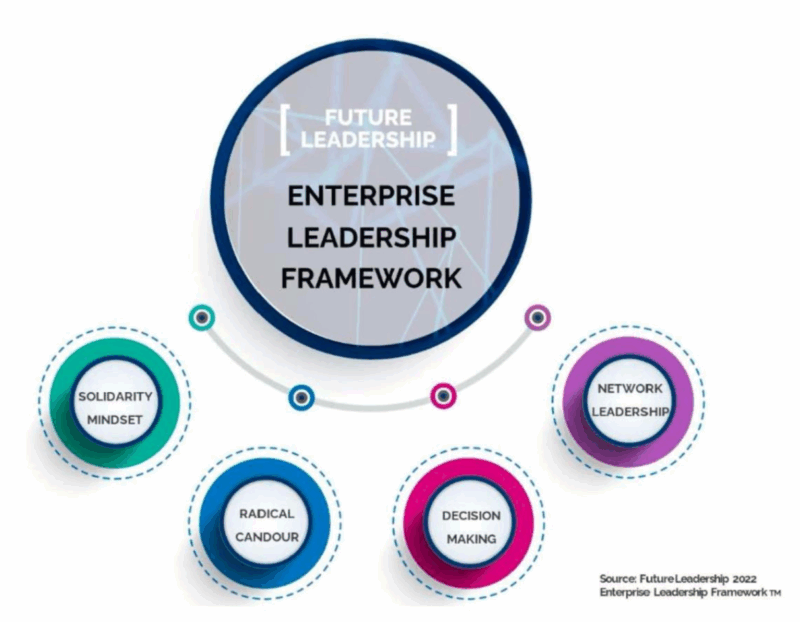
Four behaviours that define enterprise leaders
Enterprise leadership isn’t just a mindset; it translates into four specific behaviours:
Solidarity mindset: Leaders demonstrate a genuine belief that “we are stronger together.” This means supporting collective decisions even when you privately disagreed, building the muscle to stand in solidarity with leadership team decisions outside the room.
Radical candour: Drawing on Kim Scott’s work, this involves balancing care and candour in feedback, leaning into discomfort when calling out issues that might be unpopular or fear-provoking, and contributing to peer conversations even when they fall outside your direct responsibilities.
Decision making: Enterprise leaders see themselves as custodians of the business unit, function, or organisation as a whole. They speak up when decisions aren’t in the organisation’s best interest, contribute to decisions that barely impact their own area, and ensure component parts move forward in alignment.
Network leadership: This is about multiplying impact through connection and inclusion, connecting teams rather than just directing work, giving visibility to work you’re not personally involved in, and understanding the indirect flow-on effects of decisions across the system.
Understanding context is critical
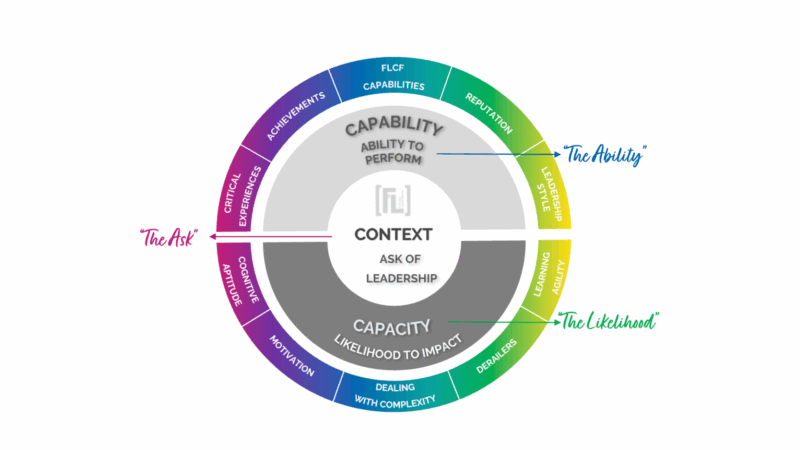
Not all public sector leadership roles demand the same capabilities. A leader at Services Australia faces different challenges than someone at the Bureau of Meteorology or a state hospital system. Context varies based on the nature of work, stakeholder environments, media exposure, and interaction with industry or citizens.
This means HR and talent leaders must move beyond one-size-fits-all approaches. The ask of leadership – what’s genuinely required for effectiveness in a specific role – needs to be clearly defined. Only then can organisations identify the right capabilities to develop and the experiences needed to build them.
For organisations that interact heavily across public and private sectors, this might mean carefully bringing in external talent. Future Leadership takes an approach we call “Model of Leadership”. Acknowledging that success requires focus on context, capability and capacity. The level of political acuity and tolerance for ambiguity required in the public sector is sophisticated, and not everyone will thrive in that environment.
Practical implications for talent leaders
The shift to enterprise leadership has clear implications for how public sector organisations develop their people:
Distinguish technical from leadership capability: Many public sector careers progress based on deep technical expertise, which is valuable. But at some point, future leaders need opportunities to broaden beyond their specialty. You cannot wait until someone is a deputy secretary to suddenly develop an enterprise mindset.
Create cross-boundary experiences: Talent functions need to think strategically about the right point in someone’s career to move them across the organisation or into other agencies. Secondments, complex cross-agency projects, and rotations aren’t nice-to-haves—they’re essential development experiences for enterprise leaders.
Invest in structured development early: While learning happens continuously throughout careers, structured leadership development programs play a crucial role. The key is not just asking “what programs should we put people on?” but “what experiences do they need, and how do we create those opportunities?”
Take a connected view of talent: Individual agencies often struggle to develop enterprise leaders on their own. This demands coordination from central agencies, whether Public Service Commissions, the Premier’s Department, Prime Minister and Cabinet, or similar bodies, working with the most senior leadership teams to think collectively about developing the next generation.
Leadership development cannot be left to chance or accumulated solely through years of service. As one leader noted, “You can’t wait until you’ve been in the sector for 30 years and you’re a deputy secretary and all of a sudden start to have an enterprise mindset.”
Moving forward
In an era when trust in leaders and institutions feels fragile, when public discourse is polarised, and when the pace of change is relentless, the public sector cannot afford leadership that operates in silos.
The challenges facing society, from climate change to healthcare transformation to housing affordability, are simply too complex, too interconnected, and too important. They demand leaders who can work across boundaries, put collective interests ahead of individual agendas, and multiply their impact through connection and inclusion.
For HR and talent leaders in the public sector, the path forward is clear: identify high-potential leaders early, give them cross-agency experiences, invest in structured development that builds enterprise capabilities, and coordinate talent strategy across the sector.
Our public servants are ready, they remain committed to purpose and service. The question is whether leadership development is evolving quickly enough to meet the moment.